
Read the latest news about our research group and the projects we are working on
October 2026
Our PhD student Suhas travelled to Spain to present his poster at the MICRO 2026 International Conference.
From 12 to 16 October 2026, the sixth edition of MICRO: Plastic Pollution from Macro to Nano took place in Cádiz, Spain. This international conference brings together researchers and other stakeholders from around the world to exchange knowledge on plastic pollution, ranging from larger plastic debris to microplastics and nanoplastics.
During the conference, Suhas presented his poster on our team's research into the factors that may influence the amount of microfibres released during laundry. These include various aspects of the washing process and the properties of textiles that may affect the number of fibres released.
To better understand these potential factors, the research combines evidence from different research methods. This approach, also known as triangulation, helps us identify recurring patterns, explore relationships between factors, and gain a better understanding of how different factors may influence one another.
On his poster, Suhas also presented the preliminary insights from a Group Model Building session. During such a session, participants work together to develop a model of a complex issue. By bringing together knowledge and experiences from different perspectives, they can identify potential causes, connections between factors, and important research questions.
September 2026
Our research is on display at the new ARTIS Aquarium!
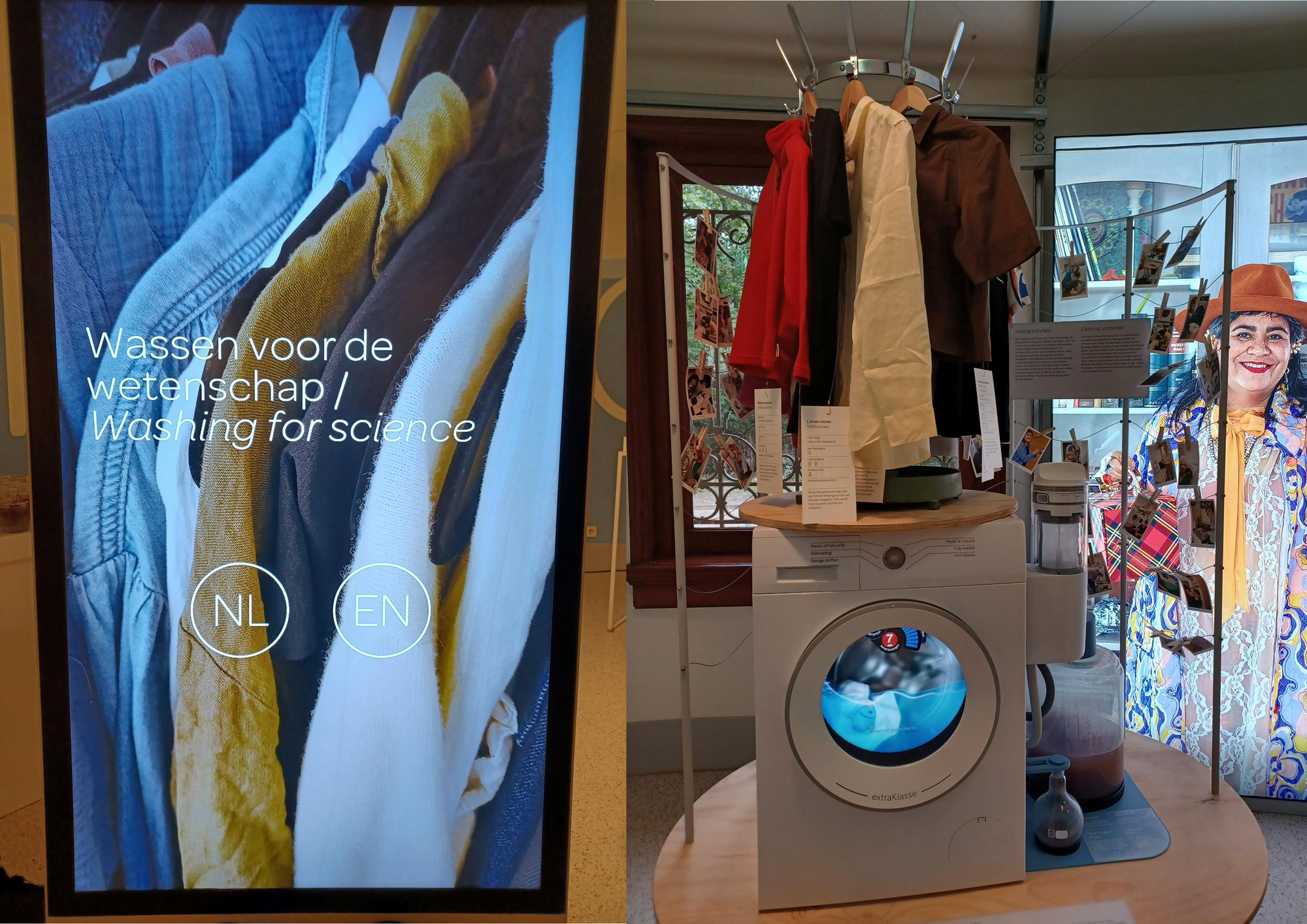
We are proud to share that our research project now has its own installation in the new Room for Change (Ruimte voor verandering) at ARTIS Aquarium! Since its official opening on 22 September 2026, visitors have been able to explore our installation and learn more about the microplastics and textile fibres released when washing clothes.
Through the Room for Change, ARTIS provides a platform for universities, universities of applied sciences, NGOs, artists and nature organisations dedicated to water and aquatic life. The space brings together inspiring initiatives that contribute to greater knowledge, awareness and positive change. We are proud that our research is part of this initiative!
And the best part? Our dedicated participants, who have worked so hard to contribute to our research, are also featured in the installation!
Curious about our research? Visit ARTIS Aquarium and discover how citizen science contributes to research on microplastics and the protection of our aquatic environment!
Augustus 2026
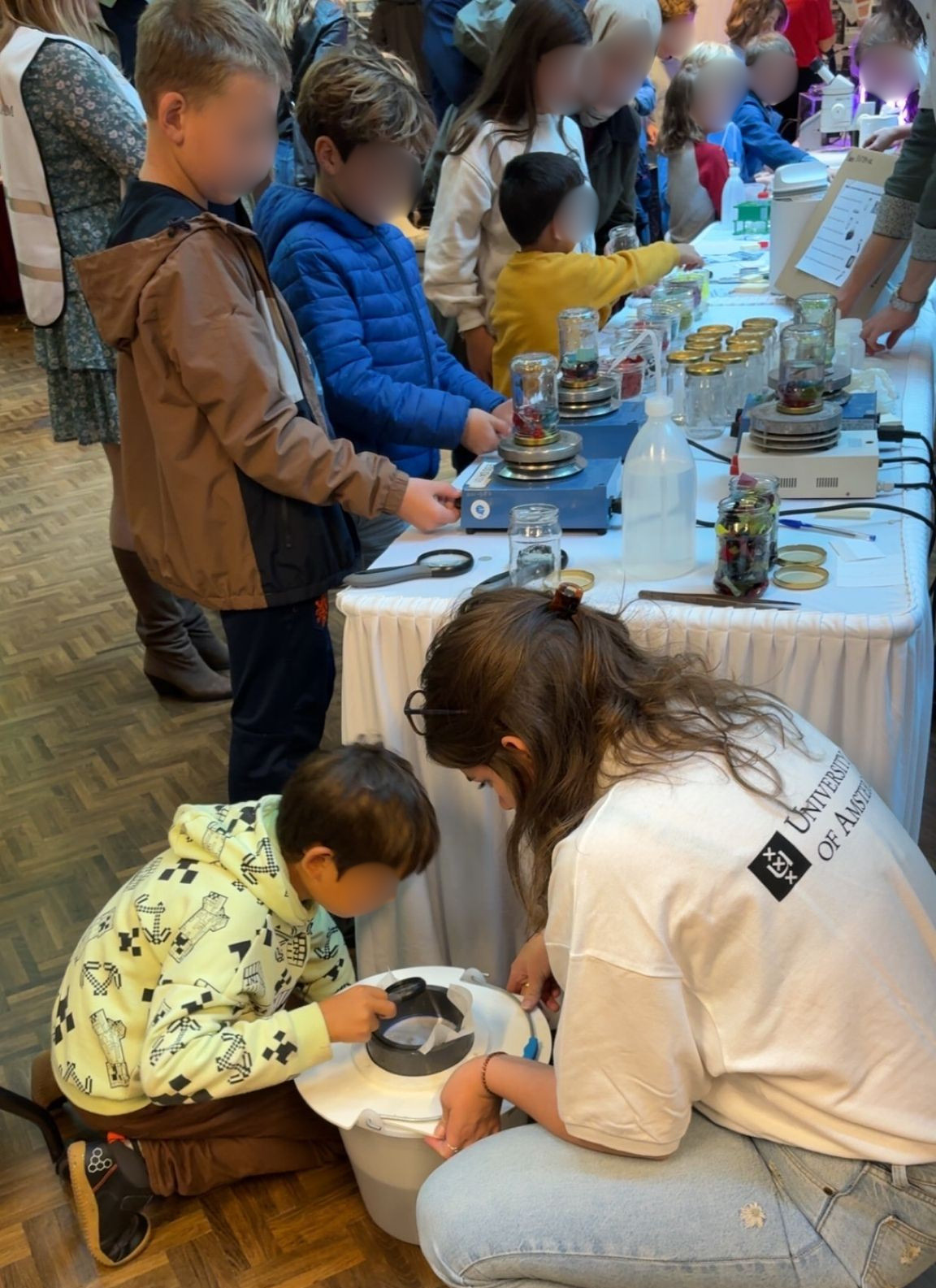
Curious about our research? Meet our research group on October 3rd at the Amsterdam Science Park Science Day!
Science Day is an opportunity for people of all ages to discover science, learn about the research taking place on campus and meet the researchers.
Together with citizen scientists, we investigate when microfibers are released during washing, where they end up and, most importantly: what can we do to reduce these emissions?
Curious to see what this looks like? Come and visit us during Science Day! We will have a mini demonstration showing how fibers are released from clothing during washing. Our researchers will also be happy to tell you more about our previous citizen science projects and our current research, in which people throughout the Netherlands collect microfibers from their laundry at home using a microplastic filter.
Everyone is welcome. Whether you are a young scientist in the making, interested in sustainability and clothing, or simply curious about science: come and visit us!
📅 3 oktober 2026 | 🕛 12:00–17:00 | 📍 Amsterdam Science Park | Website link
June 2026
Bachelor’s student investigates the development of a self-test to estimate how many fibers are released from clothing during washing.
What if there were a simple self-test that consumers could use to estimate how many fibers might be released from their clothing during washing? This is the question that one of our bachelor’s students explored. Building on the method we used during Alle Scholen Verzamelen, the method was further refined and tested on three materials: 100% cotton, 100% polyester and a 50/50 polyester-cotton blend.
In this first version of the self-test, the student demonstrated that it is possible to detect differences in fiber emissions between the different materials and that these differences are comparable to those found using a filter test. With further research and validation, we hope to develop a reliable but simple method that consumers can use to estimate how many fibers their clothing releases.


May 2026
Master’s student analyses the first results of the SustainaLab project, where participants came to campus to do their laundry. What have we learned?
After being open for two years, we have welcomed a total of 25 unique participants to SustainaLab. Together, these participants completed around 200 loads of laundry and removed a total of 39 grams of fibers from the wastewater, roughly the same weight as a pair of socks.
On average, around 0.200 grams of fibers were released per wash. That may not sound like much, but if we assume that an average Dutch household does laundry twice a week and that the Netherlands has around 8.5 million households, these figures would mean that approximately 3,300 kg of fibers are released every week in the Netherlands. An average T-shirt weighs around 180 grams. This would mean that the equivalent of more than 18,000 T-shirts ends up in the sewer system every week.
Our student did not only look at how many fibers were released, but also at the factors that influenced these emissions. One factor stood out in particular: it is important to wash with the drum as full as possible. Our data showed that the fuller the drum was, the fewer fibers were released and captured by the filter.
April 2026
Lies Jacobs becomes project coordinator of R3CIRCLE: a new NWO project for a more sustainable and circular clothing industry.
Good news! NWO has awarded a KIC grant to R3CIRCLE, a new consortium led by our very own Dr. Lies Jacobs. Within R3CIRCLE, universities, universities of applied sciences and 32 societal partners are working together to find ways to reduce the environmental impact of the clothing industry. The project focuses on developing and testing interventions related to fast fashion, sportswear and reusing existing clothing. The aim is to encourage consumers to make more sustainable choices and contribute to a circular clothing system. At the UvA, we investigate how behavioural change can be measured and how these changes ultimately contribute to the health of our planet.


April 2026
Not the researchers, but Dutch citizens take the lead. In this project, participants develop their own strategies to reduce microfiber emissions and test them at home using a microplastic filter.
In a sister project, we are expanding our latest research. Supported by the LEADER Aanjaaggroep for rural development in the Weidse Veenweiden, participants from Utrecht-West will also start using a microplastic filter. Just like our participants from the rest of the Netherlands, this group will collect fibers released during washing over a period of six months. The difference is that this group will first collect fibers from ten washes while doing their laundry as they normally would. They will then experiment with different measures to reduce fiber emissions over the course of twenty washes.
October 2025
We welcome two new PhD researchers to our research group: Riko Kimura and Suhas Puranik!
Riko (upper photo) conducts research in environmental science and focuses on the polymer types, sizes and quantities of microfibers emitted by households. In the laboratory, for example, she investigates how many polyester and nylon fibers from households end up in the environment.
Suhas (lower photo) conducts research in environmental modelling. He investigates which factors influence microfiber emissions and what happens to these fibers when they enter rivers. Among other things, he studies the transport and distribution of microfibers in aquatic systems.
Through their research, Riko and Suhas help us better understand where microfibers come from and where they eventually end up. Welcome to the team!


October 2025
From the campus to washing machines at home. In our latest project, 80 households will install a microplastic filter on their washing machine and collect fibers from their laundry.
In our latest project, participants from across the Netherlands install a microplastic filter on their washing machine at home. Over a period of six months, our participants collect data about their laundry habits: what they wash, which washing programs they use, which laundry products they use, how full they load the drum and how often they do their laundry. After every three washes, participants collect the fibers and send them to the university. Using all these data and the collected samples, we will look for patterns in microfiber emissions.
May 2025
Our first scientific article has been published! Dr. Cameron Brick and Anna Bosshard analysed the questionnaires completed by participants during the META project.
In addition to collecting fibers from laundry bags, our participants completed questionnaires about their knowledge, attitudes and beliefs regarding microplastics from washing clothes. One thing that stood out was that our participants already strongly identified as environmentally conscious before taking part. After participating in the project, we found that they had become slightly more aware and that their sense of responsibility had increased somewhat. However, after participating, they felt less strongly that they could contribute to solving the problem by using these laundry bags. This suggests that interventions aimed at changing the way people do their laundry may be more effective when they focus on changing habits and teaching skills. Focusing mainly on increasing people's motivation to live in an environmentally friendly way is probably less effective. This is a valuable result that we are taking into account in the design of our latest project.


October 2024
Antonia Praetorius receives prestigious Vidi grant to investigate the accumulation and impact of microfibers in Dutch rivers.
Antonia has received the prestigious Vidi grant to continue her research on microplastics in the environment. Antonia wants to understand what happens when microfibers continue to accumulate in our rivers over many years. Using our unique dataset collected by citizen scientists, Antonia and her research team hope to predict current and future microfiber emissions into Dutch rivers. By combining models and experiments, they will also investigate the amount of microfibers at which natural processes in river sediments may become disrupted. Ultimately, interactive maps will be developed to show how microfibers could accumulate in the Netherlands under different future scenarios.
June 2024
The research continues and our team launches a new project in collaboration with SustainaLab: doing laundry for science at the Amsterdam Science Park campus.
People who live close to the Science Park campus can come to SustainaLab to do their laundry for science. Participants book a timeslot on our website and bring their laundry to the campus. There, they wash their clothes and complete a short questionnaire. We then collect the fibers using a filter connected to the washing machine.


April 2024
The first results of Pluis het uit have been examined. 1,500 children collected 2,200 data points for us, but what do these results tell us?
Most of the clothing examined by the children was relatively new and often consisted of T-shirts or sweaters. The clothing was mainly made from cotton or polyester. Trousers released slightly more fibers on average than T-shirts and sweaters. We also found that fabrics consisting mainly of cotton released more fibers on average than fabrics consisting mainly of polyester. This does not mean that polyester is better, as polyester breaks down extremely slowly in the environment. It is also important to remember that this sticker test only provides an indication of how many fibers may be released from a small area of clothing during washing. To learn more about how many fibers are actually released during washing, we are now developing a new project.
December 2023
Students, PhDs, postdocs, statisticians and professors came together for the first interpretation of the META results. What can we conclude from this initial analysis?
Of the 100 citizen scientists who started the project, 70 participants eventually completed it. A total of 450 washes were recorded, the fibers were collected and all samples were scanned. This is considerably fewer than the 1,000 washes we had hoped to collect. Conversations with participants showed that using the laundry bags required a lot of work and that it was not immediately visible how many fibers were being released during washing.
However, the scans showed that thousands of fibers can be released during a single wash. By combining questionnaire data about the washes with information about the length and number of fibers found in the scans, we can determine how many fibers are released per gram of textile. We are also investigating which factors influence these emissions. The statistical analysis is still ongoing.


March 2023
A new project begins, and this time we are working with children from across the Netherlands. What can these young researchers discover for us?
In collaboration with Alle Scholen Verzamelen, primary school children will work with specially developed teaching materials about microplastics from clothing. Under the guidance of their teacher, the children investigate their own clothing. Using a sticker, they collect microfibers from their clothes and examine them with a magnifying glass. How long is the fiber? How thick is it? Is the sticker completely covered in fibers, or are there only a few? They also investigate what their clothing is made from and record how old the garment is.
February 2023
META is in full swing and our participants are busy collecting fibers and completing questionnaires. Curious about how it is going?
Following an article in WeesperNieuws, it did not take long for 100 participants to sign up and receive a box containing all the research materials. More than 300 samples have already been received, and our students are working hard to scan all these plastic sheets using a high-resolution scanner. In addition, the students are developing a program that can automatically count the number of fibers in the scans and determine their length.


November 2022
The META project, Microplastics Emissions from Textiles Amsterdam, is starting! We are looking for 100 participants who want to do their laundry for science.
Participants receive a laundry bag that captures microfibers during washing. They select up to four garments and record several details about them: their weight, the age of the garment and the materials it is made from. These garments are then placed in the laundry bag and washed in the washing machine. Participants also record information about the washing program, such as the type of detergent, the duration, temperature and spin speed of the program, and how full the drum is.
After the wash, participants remove the clothing from the bag and allow the bag to dry. They then use a lint roller to collect the fibers from the bag. These fibers are attached to a plastic sheet and sent to the UvA for analysis. Participants have three months to collect data from ten washes.